Leads don’t wait, and neither should your sales team. When your lead routing is slow or based on gut feelings, you’re probably leaving money on the table.
Lead distribution software lets you get the right lead to the right rep at the right moment. It reacts in real time, balances workloads, and helps you win deals before competitors respond.
This guide lists the five best lead distribution software options that actually keep up with your sales team.
Get leads to the right rep before competitors even respond. Book a demo with Standard Information!
TL;DR
Here are the five best lead distribution software solutions in 2026:
- Standard Information
- LeanData
- Pipedrive
- boberdoo
- LeadByte
Common Lead Distribution Methods
Check out the most common lead distribution methods below.
Round-Robin Lead Distribution
Round-robin lead distribution follows a simple rotation. Each new lead goes to the next person in line, then the cycle repeats.
Let’s say you have three sales reps. The first record goes to the first rep, the next record goes to the second, and the third record goes to the third. Then, the fourth lead returns to the first rep.
Many companies use this approach early in their sales process because it is easy to manage. It further boosts speed-to-lead and reduces response times, which helps deals move forward before prospects lose interest.
Some reps, however, may receive more leads than others if managers set custom criteria tied to experience or workload.
Territory-Based Lead Routing
Territory-based lead routing assigns prospects based on defined boundaries. Those boundaries may rely on geographic location, company size, or industry focus.
Though issues may appear when regions grow unevenly, some territories may naturally produce more leads than others, which can overload one group while another waits.
Teams often pair territory routing with backups, so incoming leads still move when someone stays unavailable.
Data-Driven Lead Distribution
Data-driven lead distribution is basically a smarter way to handle lead assignment.
The system looks at hundreds of data points in real time. That includes firmographics like company size and industry, plus supplemental data such as income, home ownership, and past performance on similar leads.
This improves conversion rates and removes human bias with data-driven decision-making.
5 Best Lead Distribution Software Options in 2026
These are the top five tools you could use to distribute leads:
1. Standard Information
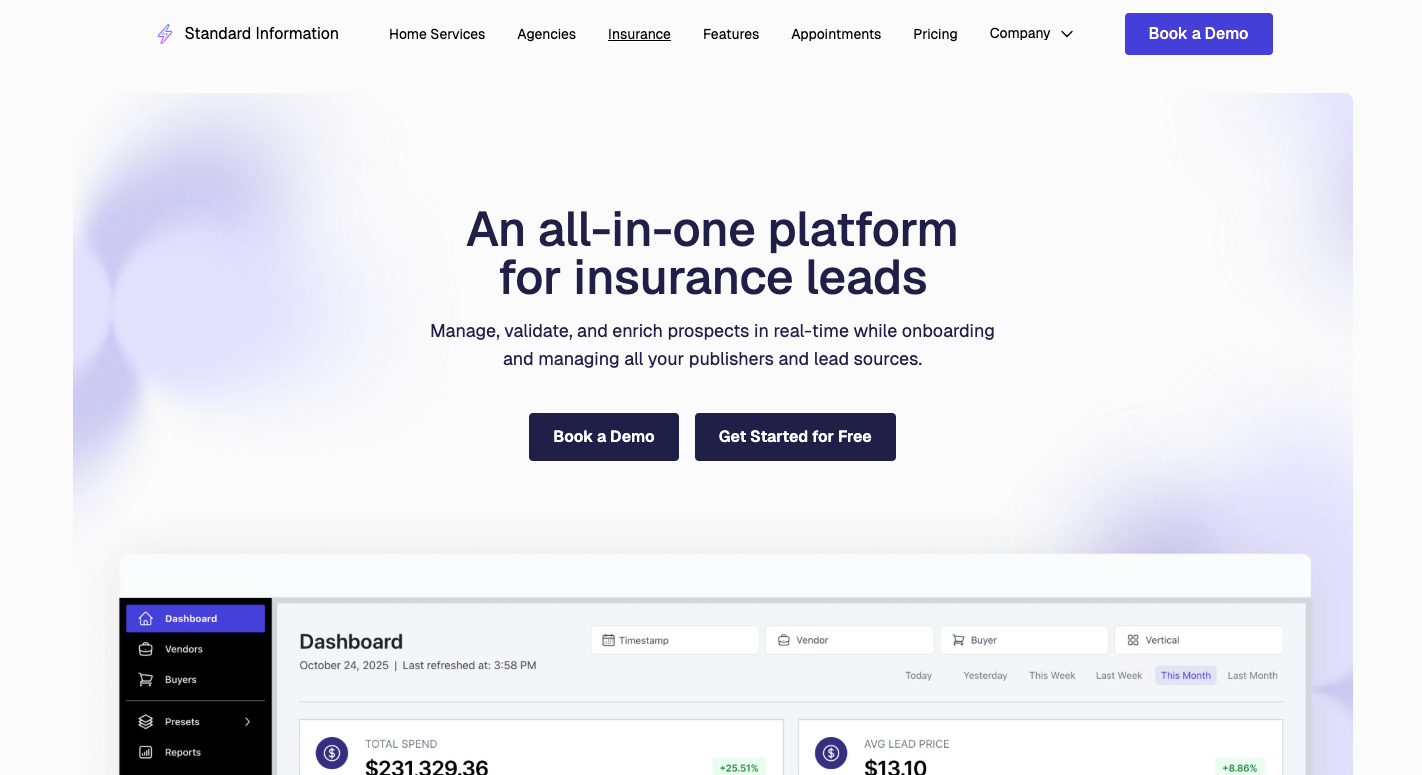
Standard Information is a high-speed lead distribution platform that you can use to buy, sell, or route large volumes of leads.
As leads arrive via web forms, partners, or ads, Standard Information scans them immediately. It instantly verifies phone numbers and emails and filters out duplicates and blacklisted profiles before you ever pay.
From there, the system pings your available buyers with partial lead data. They bid in real time, and the lead is posted to the highest bidder or the best-matched rep.
You can use templates to define what a lead looks like in your industry, such as a solar record with roof type and zip code. Existing systems connect through webhooks, so data moves without custom builds.
Lead Distribution Features Offered
- Ping-post auctions – When a lead is captured, the system sends partial, anonymized data, such as zip code and credit score, to dozens of buyers or internal teams simultaneously.
- Live bidding engine – Buyers respond within milliseconds, and the system routes the record to the top bid or best match.
- Lead validation – Phone numbers, emails, and duplicates get checked to automatically verify lead quality before routing.
- No-code lead setup – Templates define required fields, so you control the structure without writing code.
- App Store connections – Use the App Store to plug in third-party services for data enrichment, fraud scoring, or CRM syncing via webhooks.
- Trace logs – Every single lead receives a unique ID. Real-time logs show each ping, every reject reason, and the exact moment delivery happens.
- Privacy controls – Rules can scrub or delete personally identifiable information (PII) from logs after set periods to meet General Data Protection Regulation (GDPR) and California Consumer Privacy Act (CCPA) requirements.
See every bid, rejection, and sale the moment it happens. Book a demo with Standard Information!
2. LeanData

Source: leandata.com
LeanData is a Salesforce-centric lead distribution platform for the customer relationship management (CRM) system users.
Although it’s fundamentally a distribution tool, it does more than just pass leads around. It can control how records move, who owns them, and why that decision happened.
Setup happens through a visual builder. You build routing paths step by step using clear “if-then” logic, with no coding required.
A lead can follow a path when it matches an existing account and another when it doesn’t. If a rep asks, “Why didn’t I get that lead?” the audit view shows the exact path that the record followed.
It can send leads directly to the right team members and reduce overlap during outreach, too.
Lead Distribution Features Offered
- Lead-to-account matching – The system checks incoming records against existing accounts, then routes ownership based on those relationships.
- Visual routing builder – You define routing logic through a drag-and-drop builder using conditions tied to firm size, intent, or region.
- Advanced rotation pools – Distribution supports weighted splits, availability checks, and capped delivery to keep workload balanced.
- Routing for custom objects – Records beyond basic leads move through the same logic, which helps you control every data type.
- Audit trail visibility – Every decision is visible, so you can review outcomes and explain assignments.
- Salesforce-centric control – All actions occur in the CRM, which supports data accuracy during routing.
3. Pipedrive
Source: pipedrive.com
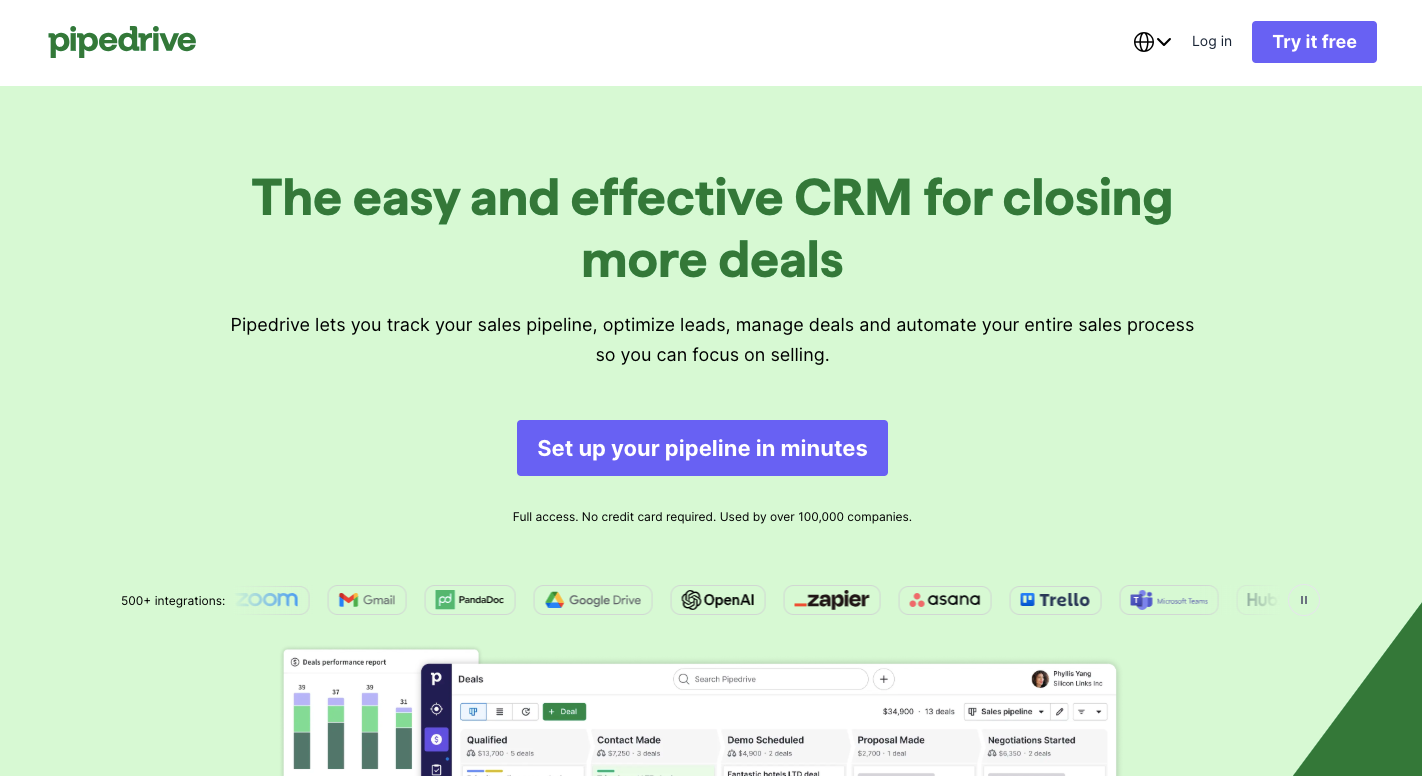
Pipedrive started as a CRM platform and later added an automated lead distribution tool.
It uses the Automatic Assignment feature to manage lead distribution and operates on a set of “if-then” logic rules you define in the system.
When new records arrive from chat, imports, or web forms, the system checks predefined criteria, such as geographic location (e.g., Country = US), deal value (e.g., greater than $10,000), or specific product interest. Based on that check, ownership is set right away.
A separate inbox holds records that still need review. Incoming leads are kept until they’re qualified, which helps manage leads before pushing them into active deals.
Lead Distribution Features Offered
- Conditional routing rules – You can create branching logic based on lead data to send records to different owners based on value or intent.
- LeadBooster tools – A suite of tools, including chatbots and web forms, that qualify prospects instantly before assignment.
- Leads Inbox – A staging area where new, unquantified leads are stored. You can filter and sort them here before they’re converted to active deals in your pipeline.
- Territory assignment – By using custom fields for “City,” “Zip Code,” or “State,” you can create automation rules that assign leads to specific territory owners automatically upon creation.
- Team setup controls – In the Manage Users section, group reps into teams such as “East Coast Sales” or “Enterprise Team.”
- Built-in routing – Because the distribution is built in, you don’t have to worry about data syncing issues between separate routing and CRM tools.
4. boberdoo
Source: boberdoo.com
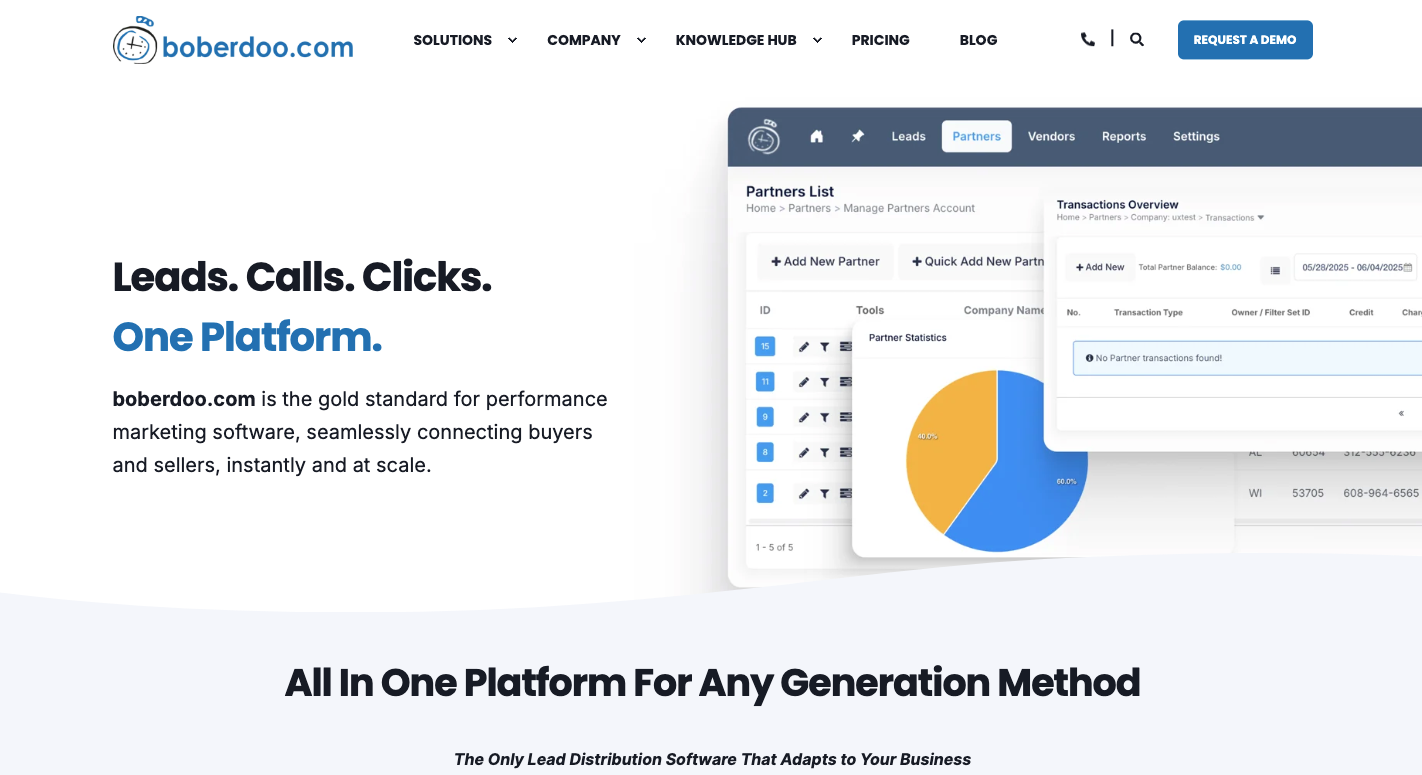
boberdoo operates on a “Lead Routing Logic” that goes far beyond a simple loop.
Each record entered gets checked, priced, and offered to buyers who want it. That flow removes manual routing and cuts down manual oversight once rules are in place.
You start by defining what a lead looks like. Then you add your clients as “Partners.” You set their budget, their working hours, and their specific filters, such as “Only leads in California.”
When a record arrives, the system evaluates it and decides where it should go. Within seconds, it posts the lead data to the buyer’s CRM or sends it via email or SMS, which supports operational efficiency when volume stays high.
If you’re not selling leads but need distribution logic for a large internal team, the same setup can still work.
Lead Distribution Features Offered
- Ping-post routing – Partial details go out first, buyers respond, then the full record goes to the winner.
- Dynamic pricing rules – Unlike static systems, the platform can change the price or priority of a lead in real time based on attributes. A mortgage record with a strong credit score may route to a premium buyer pool.
- Exclusive and shared delivery – You can configure the system to sell a lead to one buyer for a higher fee or to multiple buyers at a lower price. Caps limit how many times a shared record gets sold.
- Advanced buyer filters – Partners define limits by time, volume, and criteria so only relevant records reach them.
- Manual marketplace access – Buyers can select records directly when deals need a human choice.
- Inbound call handling – Phone calls follow the same routing logic as form submissions.
- Full audit visibility – Every single ping and post is logged so you can see bids, winners, and skipped buyers.
5. LeadByte

Source: leadbyte.co.uk
LeadByte operates as a control layer between lead sources and delivery targets.
Agencies and brokers rely on it when they need data management and a system that routes leads. Yet, it doesn’t replace a CRM. It prepares records so that another platform can handle managing a long-term sales pipeline.
Before any distribution happens, LeadByte scrubs the data. It uses real-time services to verify phone numbers through home location register (HLR) checks and confirm email addresses, which filters out junk before delivery. That step reduces risk and limits the need for manual intervention later.
After validation, the system applies delivery rules. An algorithm identifies if a new lead belongs to an existing account in your system, then decides where it should go.
Once matched, the lead is pushed to the buyer’s endpoint. Some teams also use the platform for immediate scheduling after delivery.
Lead Distribution Features Offered
- Multi-source intake – Records arrive via application programming interfaces (APIs), webhooks, batch uploads, or forms, keeping capture simple.
- Real-time validation – Phone and email checks remove low-quality entries before routing begins.
- Buyer and team setup – You set up “Buyers” or “Sales Teams” and define their requirements. You can set caps (e.g., only five leads per day) and schedules like office hours only.
- Routing methods – The system supports priority delivery, weighted splits, and price-driven paths for leads based on demand.
- Partner visibility – Buyers and suppliers see delivery stats, budgets, and results through shared dashboards.
Control and Optimize Lead Distribution With Standard Information
Standard Information gives you a unified system to decide what happens to every lead. Nothing gets passed around blindly.
Once you receive leads, phone numbers and emails get checked right away. After that, Standard Information sends partial details to buyers who want them. They bid in real time, and the top offer wins.
Delivery happens seconds later. You can watch the whole flow and get real-time insights into what sells and where money drops off.
No-code templates define what a lead looks like for your lead vertical. You set caps and schedules so buyers or reps never get overloaded. Connections with existing systems happen through webhooks and apps.
Overall, Standard Information helps with lead distribution and your business needs.
FAQs About the Best Lead Distribution Software
What is a lead distribution platform?
A lead distribution platform is a lead routing tool that decides where inbound leads go the moment they enter your system.
Website visitors submit a form, the platform reviews the data, and then routes the record through predefined lead distribution workflows. Everything operates in a single place, enabling seamless integration with existing tools and keeping routing consistent across multiple channels.
What are the benefits of using a lead distribution system?
A lead distribution system shortens response times and helps you reach prospects. Records land with the right people quickly, which often lifts sales performance and helps you capture the most revenue from each campaign.
Managers also gain visibility into vendor performance, see how records move, and adjust routing rules. Automated reminders further reduce follow-up gaps, while distributed evenly workloads protect reps from burnout.
What key features should you look for in lead distribution software?
Choose software that offers routing rules, detailed analytics, and control over lead flow. Look for platforms that support data checks, sales performance tracking, and alignment with your marketing strategy.
What is the difference between lead routing and lead distribution?
Lead routing focuses on choosing the next destination. Lead distribution covers the full process, from intake to assignment, measurement, and optimization.